
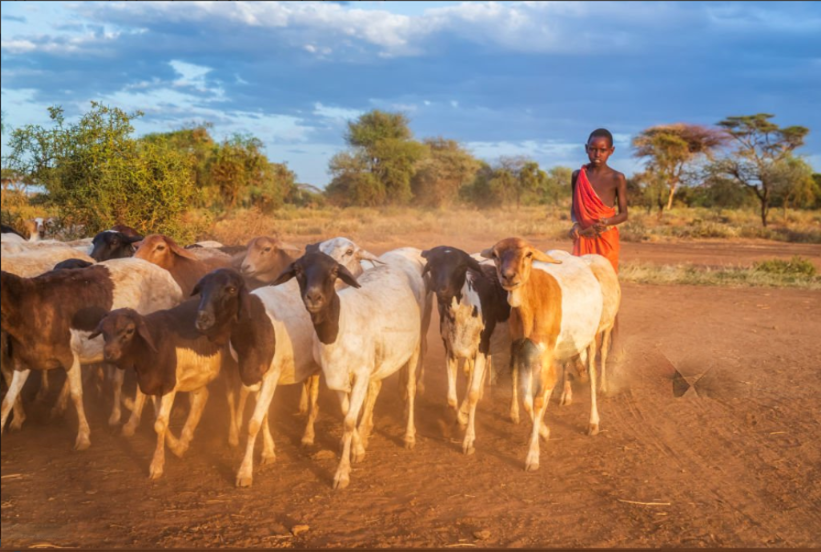
Pastoralist communities do not generate income through randomness or chance.
They do so through deeply embedded systems, refined over generations that balance survival, growth, and resilience in some of the world’s most challenging environments. Among the Maasai of East Africa, income generation is not separated from daily life. It is woven into livestock management, seasonal movement, social networks, and long-term planning. One of the most important pillars of this system is goat trading.
Income as a System, Not an Event
In many modern economic models, income is treated as a single transaction: earn, spend, repeat.
Pastoralist systems operate differently.
Income is generated through:
- Asset accumulation (livestock as wealth)
- Selective liquidation (selling only when conditions are right)
- Reinvestment (education, land access, trade, or herd improvement)
- Risk distribution (across species, locations, and seasons)
This approach ensures households are not forced to sell assets under pressure, which is one of the main causes of long-term poverty in fragile economies.
Why Goat Trading Plays a Central Role
Goats occupy a unique position within pastoralist economies because they balance three critical factors:
- Sustainability
Goats thrive in arid and semi-arid lands where rainfall is unpredictable and pasture is sparse. They require less water than cattle, recover quickly after drought, and can survive on diverse vegetation.
- Liquidity
Unlike larger livestock, goats can be sold quickly and in small numbers. This allows households to meet immediate needs like school fees, medical costs, or food purchases without dismantling their entire asset base.
- Cultural Alignment
Goat keeping and trading fits naturally within Maasai social and cultural structures. Knowledge of breeding, health, and market timing is widely shared and passed down, reducing dependence on external expertise.
Together, these factors make goats one of the most financially flexible assets in pastoralist communities.
Diversification as a Survival Strategy
Sustainable income among pastoralists depends on diversification, not specialization.
Households typically:
- Maintain herds of different sizes and species
- Sell animals selectively rather than continuously
- Spread risk across geography and time
- Combine livestock income with small trade, wage labor, or land leasing
This diversification protects families from shocks such as drought, disease outbreaks, or market fluctuations.
Reinvestment: Turning Livestock into Long-Term Opportunity
Income from goat trading rarely disappears into short-term consumption alone. Instead, it is often reinvested into:
- Education (school fees for children)
- Land access (leasing or securing grazing rights)
- Small businesses (shops, transport, trading)
- Herd improvement (better breeding stock or veterinary care)
In this way, livestock functions as both a store of value and a growth engine.
Impact Investing Before the Name Existed
What is often overlooked is that pastoralist systems resemble what today would be called impact investing.
Livestock assets:
- Grow over time
- Provide food security
- Generate income
- Convert to cash when needed
- Support entire community networks
These systems deliver economic, social, and environmental returns simultaneously long before development jargon existed.
Why External Interventions Often Fail
Many well-intentioned development programs fail because they attempt to replace pastoralist systems rather than strengthen them.
Common mistakes include:
- Introducing unfamiliar income models
- Ignoring seasonal movement patterns
- Treating communities as beneficiaries instead of economic actors
- Disrupting existing risk-management strategies
When external partners fail to understand local systems, outcomes are often short-lived.
Strengthening What Already Works
The most effective interventions respect pastoralist logic and focus on:
- Improving market access
- Reducing preventable risks (such as disease)
- Supporting community-led coordination
- Enhancing transparency and documentation
Some emerging community-centered initiatives such as those explored through platforms like ProsperGenics, are beginning to document and learn from these systems rather than override them.
Conclusion: Sustainability Rooted in Reality
Pastoralist communities generate income sustainably because their systems are adaptive, asset-based, and culturally grounded. Goat trading is not merely a livelihood, it is part of a broader economic logic that prioritizes resilience over short-term gain.
As interest grows in ethical investment, climate resilience, and locally driven development, these systems offer powerful lessons, not as relics of the past, but as models for the future.