
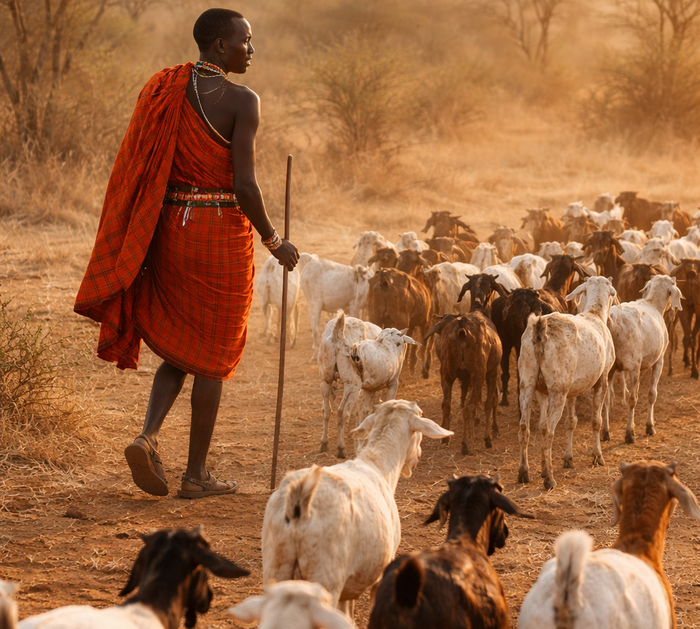
Goat trading has long been a cornerstone of Maasai livelihoods. Beyond tradition, it represents a resilient, scalable, and commercially viable investment model, especially in Kenya’s arid and semi-arid lands (ASALs), where conventional agriculture often struggles.
When structured intentionally, goat trading evolves from a subsistence activity into a repeatable investment system that combines predictable cash flow, climate resilience, and community impact.
- Why Goats Make Economic Sense in Arid Regions
Goats are uniquely suited to dryland economies:
- Require minimal startup capital
- Reproduce quickly compared to cattle
- Are easy to liquidate in local markets
- Maintain strong demand year-round
Because goats mature fast and trade frequently, capital turnover is high, making them attractive even to small-scale investors.
Typical economic cycle (contextual):
- Purchase price: KES 3,000–5,000
- Feeding & care (3–6 months): KES 1,000–2,000
- Sale price: KES 7,000–12,000+
Returns vary by season and market access, but goats consistently outperform many rural income alternatives.
- Climate Resilience and Risk Management
In the face of drought and climate uncertainty, goats outperform most livestock because they:
- Survive on sparse vegetation
- Require less water
- Recover quickly after climate shocks
- Can be relocated easily
For Maasai households, goats function as living financial buffers, convertible into cash when emergencies arise. This makes them one of the most reliable assets in climate-stressed environments.
- How the Goat Trading Model Works in Practice
A structured goat trading model typically follows four interconnected stages.
a) Sourcing and Selection
Goats are sourced from:
- Pastoral households
- Local livestock markets
- Community aggregation points
Selection focuses on health, age, and growth potential.
b) Fattening and Herd ManagementOver a short cycle:
- Supplementary feeding improves weight
- Preventive veterinary care reduces losses
- Group herding lowers costs
This phase adds the most value with the least infrastructure.
c) Market Timing and Sales
Sales are timed around:
- Urban demand spikes
- Festive seasons
- Bulk buyers and institutions
The biggest advantage here is liquidity, goats rarely wait long for buyers.
d) Profit Recycling
Profits are often reinvested into:
- Larger herds
- Improved breeds
- Shared water and feed systems
This creates compounding growth rather than one-off income.
4. Social and Community Impact
Beyond income, goat trading supports:
- Women and youth participation
- Informal savings and investment groups
- Skill development in animal health
- Improved household food security
When coordinated across communities, goat trading becomes a local economic engine rather than an isolated activity.
This is where structured, community-aligned platforms matter, connecting capital, knowledge, and markets without disrupting cultural systems.
- Why This Model Attracts Long-Term Investors
For NGOs, donors, and private investors, goat trading offers:
- Asset-backed value
- Short investment cycles
- Measurable social impact
- Alignment with climate and development goals
Some emerging community-driven ecosystems are quietly exploring how to document, structure, and scale such models responsibly.
- Risks and How They Are Managed
Key risks include:
- Disease outbreaks
- Market price fluctuations
- Drought stress
Mitigation strategies:
- Preventive veterinary care
- Collective selling
- Grazing and water planning
- Herd diversification
Structured approaches significantly reduce these risks compared to informal trading.
- Conclusion: A Grounded Investment with Lasting Value
Goat trading may appear simple, but its strength lies in predictability, resilience, and scalability. Rooted in Maasai knowledge and adaptable to modern investment frameworks, it offers a rare blend of:
- Economic returns
- Climate resilience
- Social stability
- Cultural continuity
As interest grows in ethical, community-led investments, goat trading stands out as a quietly powerful model worth serious consideration.